
What Is a Freight Forwarding Company?
A freight forwarding company organizes the movement of goods from their origin to their destination. It coordinates carriers, bookings, shipping documents and other agreed services, which may include collection, customs support and final delivery. The forwarder is not necessarily the business physically transporting your goods; its responsibilities depend on the services you book.
For a UAE business, the practical question is simple: who connects the supplier, transport provider, customs representative and receiving warehouse? Understanding those responsibilities helps you ask for the right service instead of discovering a missing step after the cargo has left. The useful outcome is a shipment plan you can act on: when the supplier should be ready, what your team must approve, which costs are yours, and what needs to happen before the receiving warehouse can accept the goods. Start with those questions.
What does a freight forwarding company do in practice?
A freight forwarding company brings the shipment’s separate arrangements together. Rather than booking transport in isolation, it helps coordinate the people, information and handovers needed to move the goods.
Imagine a Dubai retailer ordering three pallets of furniture from an overseas supplier. In this illustrative example, the retailer books supplier collection, sea transport, customs coordination and warehouse delivery. The forwarder arranges those stages; the supplier prepares the goods and commercial documents; the retailer confirms its import and receiving arrangements.
When the pallets arrive, delivery follows only after the applicable release requirements are complete. This example is not a Zline customer case study. It shows why the shipment needs more than a vessel booking: someone must connect each handover with the next.
Freight forwarder, carrier, customs broker or logistics provider?
These names describe different functions, although one business can perform more than one. A freight forwarding company coordinates shipments; an operating carrier physically moves them by aircraft, vessel or truck. A customs representative handles the customs work they are authorized to perform.
A logistics provider may cover a wider operation, including storage, inventory handling and order fulfillment. Forwarding can sit within that broader service. For more context, read our explanation of tailored logistics.
Who is responsible for each part of the shipment?

The responsibility map below follows the furniture example. It illustrates a division of work, not a universal contract. Ask your freight forwarding company to explain any differences in your booking.
| Party | Main responsibility in this example | Key handover |
|---|---|---|
| Shipper / supplier | Prepares packed goods, invoice and packing list | Releases cargo and accurate details for collection |
| Freight forwarder | Coordinates the booked transport and supporting services | Connects carriers, customs representative and delivery team |
| Operating carrier | Physically transports the accepted cargo | Transfers goods to the next agreed handling party |
| Customs representative | Handles the authorized declaration and customs queries | Communicates release status and outstanding requirements |
| Consignee / receiver | Provides import information and prepares to receive goods | Checks delivery and records discrepancies |
Ask who performs each task directly, who uses a partner, and who remains your contact when something changes. A single point of contact does not mean every activity is performed by the same company.
What services does a freight forwarding company provide?
A freight forwarding company may coordinate transport, documents, customs support, consolidation, storage and delivery. However, a service advertised on a website is not automatically included in every quotation.
Transport planning and carrier booking
The forwarder helps match the route and transport mode to your cargo, budget and deadline, then arranges capacity. Air, sea and road are transport modes; a shipment using more than one is multimodal.
FCL and LCL describe container arrangements, not additional transport modes. Full container load (FCL) gives one shipper exclusive container use. Less than container load (LCL) combines cargo from different shippers in shared container space. Neither choice should be made from the pallet count alone.
For time-sensitive goods, discuss the full collection-to-delivery requirement with Zline’s air cargo services, rather than comparing flight times alone.
Documents and customs coordination
A freight forwarding company can coordinate shipping instructions and document checks, while the seller supplies accurate commercial information. The commercial invoice records the sale; the packing list describes how the cargo is packed.
Customs coordination and authorized customs representation are not interchangeable. Identify the declaration provider and confirm the applicable procedure. Zline’s customs clearance services are a starting point for discussing support for your shipment. Dubai Customs distinguishes import, export, transit, transfer and temporary admission procedures.
Consolidation, storage and delivery
Consolidation brings smaller shipments together for transport. Storage may be needed between stages, but its inclusion, duration and charges depend on the agreement.
A freight forwarding company may also arrange collection and final delivery. Terminal-to-terminal transport has different boundaries from a door-to-door booking. Specify the addresses, loading access, delivery appointment and unloading responsibility instead of relying on the label alone.
Insurance and special handling
Ask whether cargo insurance has been arranged, who is insured, and what journey and risks are covered. Transport liability is not the same as cargo insurance, and it may not cover the goods’ full value.
Tell your freight forwarding company about fragile packaging, batteries, temperature requirements or unusual dimensions before booking. Request written confirmation that the proposed service accepts the goods and their handling requirements.
What is included, optional or excluded?
Here is a completed scope example for the furniture shipment. These are illustrative booking choices, not a Zline quotation or statement of standard inclusions.
| Included in this example | Optional additions | Excluded from this example | Responsible provider |
|---|---|---|---|
| Supplier pickup, booked sea transport and warehouse delivery | Repacking and storage beyond agreed handling | Furniture assembly and inside-room placement | Forwarder coordinates; transport and handling providers perform the work |
| Document coordination and customs representation | Cargo insurance arranged on request | Duties and taxes, payable separately by the importer | Supplier provides trade documents; authorized representative handles filing |
Before approving your own booking, ask the freight forwarding company for the same clarity. The written scope should identify included work, optional services, excluded costs and the provider responsible for each stage.
How do freight forwarding services work?
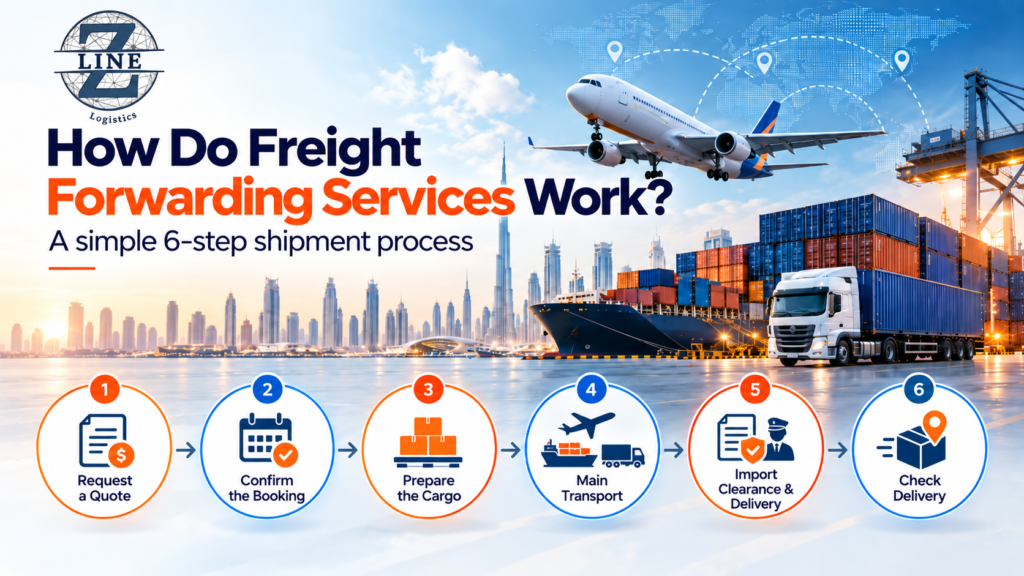
Freight forwarding usually progresses through quotation, booking, cargo preparation, export steps, main transport, import clearance and delivery. Some activities overlap: destination paperwork can be checked before the goods arrive.
Step 1: Share the cargo details and request a quote
Give the freight forwarding company the origin, destination, product description, package count, gross weight, packed dimensions, cargo-ready date and required delivery date. Include loading restrictions and special handling needs.
Ask for separate origin, main-transport and destination charges. Dimensions matter because chargeable weight can reflect the space occupied, not only the scale weight. The output should be a written quote with a defined scope, validity and exclusions.
Step 2: Confirm the booking and document owners
Once you approve the proposal, request written booking confirmation from the freight forwarding company, including the service, cutoffs and outstanding acceptance conditions. A quote approval alone does not establish that the carrier has accepted the cargo.
Name the person responsible for each document and its approval. Air shipments use an air waybill; ocean transport may use a bill of lading or sea waybill. Check party names, descriptions and quantities before the documents are finalized.
Step 3: Prepare the cargo and arrange collection
The supplier prepares the agreed packaging and labels. The collection provider receives the cargo against the booking details. The handover should leave both parties with an accurate package count and collection record.
For example, suppose 20 cartons are ready but the packing list states 18. Reconcile the actual goods with the supplier’s records and correct the relevant information before proceeding. Do not leave the next handler to decide which version is right.
Step 4: Complete export requirements and main transport
The customs representative handles the applicable export filing, while the operating carrier performs the transport. Your freight forwarding company coordinates the booked handovers and shipment updates. The sequence depends on the mode and procedure.
Agree the updates you need: cargo received, departure, schedule changes and arrival. Our air cargo tracking guide introduces tracking references and milestones. Ask which updates are actually available for your booking and who will explain any exception.
Step 5: Complete import clearance and arrange delivery
Arrival, customs release and delivery are separate milestones. The importer and customs representative address the applicable declaration, documents, approvals and payments; onward delivery follows the required releases.
Ask the freight forwarding company to distinguish an arrival notice from confirmation that the goods can be collected. Prepare the receiving address, contact and unloading arrangements while release is being coordinated. Our import customs clearance guide covers the wider document-preparation discussion.
Step 6: Check delivery and close the shipment record
Have the receiver compare the delivered packages with the shipment record and note visible damage or shortages. Keep the proof of delivery, relevant photographs and correspondence together.
Agree how discrepancies should be reported and follow the applicable claim instructions. A signed delivery record and a resolved exception are different outcomes; ask who owns any remaining action before treating the shipment as closed.
What does the customer still need to provide?
Working with a freight forwarding company does not remove the need for accurate product information and timely decisions. Assign one contact who can answer questions and approve changes.
Provide a specific description of the goods, their value, package measurements, origin information and any relevant handling requirements. Make sure the invoice, packing list and shipping instructions tell a consistent story. Certificates and product approvals depend on the cargo and movement involved.
Also confirm the importer, receiving arrangements, payment responsibilities and approval limits for additional costs. Distinguish a preferred arrival date from a deadline tied to production or a customer commitment.
Finally, align the sales terms with the shipping instructions. Incoterms rules allocate specified obligations between buyer and seller, but the sales contract and transport contract remain separate. Your freight forwarding company needs instructions that reflect the arrangement you actually agreed.
When is a freight forwarder useful for a business?
A first or one-off shipment
Consider support when your team is unfamiliar with the route, documents or destination arrangements. Start with the tasks you cannot confidently manage yourself. For a straightforward small parcel, compare a courier service with freight options rather than assuming a larger service package is necessary.
Recurring imports or exports
For repeated shipments, discuss a consistent booking specification, named document owners and agreed reporting milestones. A freight forwarding company can support transport coordination while your team retains purchasing and stock decisions. Review exceptions as well as completed deliveries.
An established in-house logistics team
Outsourcing does not need to be all-or-nothing. Your team may keep planning internally and assign selected transport or handling activities externally. Broader warehousing and fulfillment needs call for a separate scope discussion. Explore Zline’s tailored logistics solutions when the requirement extends beyond one shipment.
Frequently asked questions
Does a freight forwarding company own the ship or aircraft?
Not necessarily. Many arrange capacity with operating carriers rather than owning the transport assets. Some providers combine forwarding with other activities, so verify the arrangement instead of assuming either ownership or complete outsourcing.
Can a small business use a freight forwarder?
Yes. Shared-container shipping can accommodate smaller commercial loads. Compare minimum charges, handling costs and the full delivery scope to decide whether it suits your shipment. Business size alone does not determine the right option.
Is cargo insurance automatically included?
No automatic inclusion should be assumed. Ask for written confirmation of the insurer, insured value, covered journey and exclusions. The carrier’s liability terms are not proof that separate cargo insurance has been purchased.
Does freight forwarding include customs duties and taxes?
Not automatically. Transport charges, customs-service fees and government duties or taxes are different cost categories. Have the quote identify what is covered and who pays the remaining amounts; a door-to-door description alone does not settle those responsibilities.
Can I book only part of the shipment?
Yes, where the provider offers the required scope. You might book terminal transport while arranging collection or delivery separately. Record the exact handover points and contacts so neither side assumes the other is handling an unbooked stage.
Plan your shipment with Zline Logistics

Choosing a freight forwarding company starts with the shipment, not a generic promise. Define the cargo, destination, deadline and support you need, then agree who handles each step.
Based in Dubai Airport Freezone, Zline Logistics provides freight forwarding and customs clearance support. Our freight forwarding services cover air, sea and land options, with the specific route and service scope confirmed for your cargo.
Contact Zline to discuss your shipment with the origin, destination, cargo description, package count, weight, dimensions and required delivery date. Ask for an itemized quote that makes the inclusions, exclusions and responsibilities clear before you book.


